Paycheck CalculatorHourly & Salary Paycheck Calculator (2026)
Estimate your 2026 take-home pay after taxes.
Your Pay DetailsEnter Your Pay Details
Calculate your take-home pay with 2026 federal and state tax rates.
Your Estimated Take-Home Pay
$2,368.94
Every two weeks · 2026 estimate
- Monthly
- $5,132.71
- Annual
- $61,592.50
Gross per paycheck$2,884.62
- Taxes
- $515.67
- Other deductions
- $0.00
- Net pay
- $2,368.94
Tax Breakdown
Texas has no state individual income tax on wages.
Spot something that looks wrong? Report a calculation error
This calculator provides estimates based on 2026 tax rates. Actual taxes may vary. Consult a tax professional for accurate tax advice.
Based on official 2026 IRS and state agency sources. Methodology and limitations
Tax data last reviewed: · Maintained by The Snap Pay Team against IRS and state agency sources
Quick answer
Take-home pay is your salary after federal income tax, state income tax, Social Security (6.2%) and Medicare (1.45%) are withheld. In 2026, a single filer earning $75,000.00 in a state with no income tax keeps about $61,593.00 per year — roughly $5,133.00 a month, or $2,369.00 per bi-weekly paycheck.
Gross salary (example)
$75,000.00
Annual take-home
$61,593.00
Effective tax rate
17.9%
Worked Example: How Net Pay Is Calculated
Example: a single filer earning $75,000.00 per year in Texas takes home $61,592.50 after federal tax, state tax, Social Security and Medicare — about $5,132.71 per month.
| Line item | Amount (2026) | How it is derived |
|---|---|---|
| Gross annual salary | $75,000.00 | Pay before any tax or deduction |
| Federal income tax | − $7,670.00 | 2026 IRS brackets after the standard deduction |
| State income tax (Texas) | − $0.00 | No state individual income tax on wages |
| Social Security | − $4,650.00 | 6.2% of wages up to $184,500 |
| Medicare | − $1,087.50 | 1.45% of all wages (+0.9% above $200,000) |
| Total tax withheld | − $13,407.50 | Effective tax rate 17.9% |
| Net annual take-home pay | $61,592.50 | What actually reaches your bank account |
| Net per month | $5,132.71 | 12 payments per year |
| Net per bi-weekly paycheck | $2,368.94 | 26 paychecks per year |
| Net per week | $1,184.47 | 52 payments per year |
| Net per hour | $29.61 | 2,080 work hours per year (40 h/week) |
Formula: net pay = gross pay − federal income tax − state income tax − Social Security − Medicare − state payroll taxes (where applicable) − any pre-tax and post-tax deductions. Figures are generated by the same 2026 calculation engine used by the calculator on this page.
Assumptions and what this estimate excludes
Assumes a single filer, standard deduction, no dependents, no pre-tax deductions, and 40 hours per week (2,080 hours per year), taxed in the state where the work is performed.
- • City, county and school-district local income taxes (e.g. NYC, Yonkers, Philadelphia, Ohio municipalities)
- • Health, dental and vision insurance premiums and other employer benefit deductions not entered by you
- • 401(k), HSA and FSA contributions unless you enter them in the calculator
- • Bonuses, commission, RSUs, self-employment income and investment income
- • Itemized deductions and any end-of-year refund or balance due
What Is Take-Home Pay?
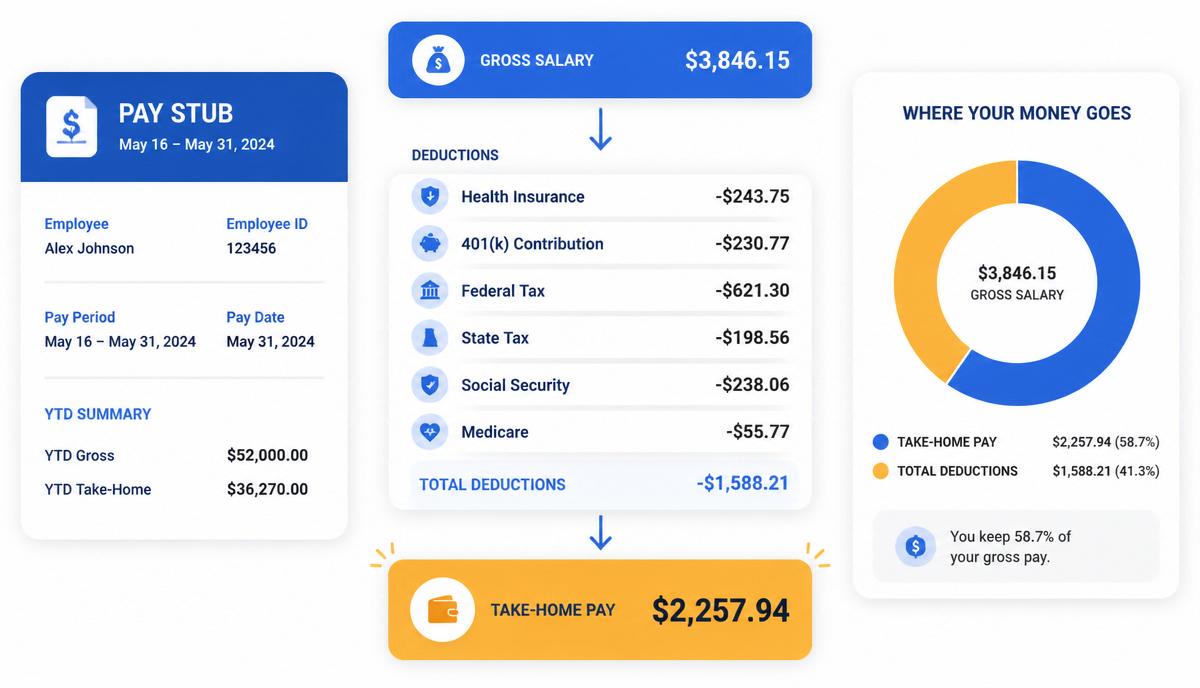
Take-home pay is the actual amount deposited into your bank account after all taxes and deductions are withheld from your paycheck. It's also called net pay.
Your employer withholds several types of taxes before you receive your paycheck:
- Federal income tax — based on your tax bracket and filing status
- State income tax — varies by state (9 states have none)
- Social Security — 6.2% up to $184,500
- Medicare — 1.45% (+ 0.9% for high earners)
Understanding your take-home pay helps you budget accurately and avoid surprises on payday. Use the reverse salary calculator if you already know your target net pay and want to find the gross salary you need.
How This Paycheck Calculator Works
Results are annual 2026 tax estimates spread over your pay periods — not a simulation of your employer's withholding tables.
Income
Hourly pay is converted with rate × hours per week × 52. Pre-tax deductions such as 401(k) and HSA lower taxable income; Social Security and Medicare are based on gross wages.
Federal income tax
The 2026 standard deduction for your filing status is applied, then the progressive 2026 brackets (10% to 37%).
State and local tax
Each state uses its own 2026 annual rules. Where a state cannot be fully calculated, the result says so instead of showing $0. Optional local tax covers NYC, Philadelphia and Maryland counties.
FICA
Social Security is 6.2% up to the $184,500 wage base. Medicare is 1.45%, plus 0.9% above $200,000 (single) or $250,000 (married filing jointly).
Sources & verification
All 2026 rates, brackets, and thresholds on this page come from the primary sources below. Snappaycalc's tax data team reviews these annually.
- Rev. Proc. 2025-32 — 2026 inflation adjustments — Internal Revenue Service
2026 federal tax brackets and standard deduction
- Publication 15-T — Federal income tax withholding methods — Internal Revenue Service
Basis for W-4 adjustments (multiple jobs, dependent credits, extra withholding); results are annual estimates, not a per-period withholding simulation
- 2026 Social Security wage base announcement — Social Security Administration
FICA / OASDI wage base and rates for 2026
- Additional Medicare Tax — Topic no. 560 — Internal Revenue Service
0.9% surtax on wages above threshold
State Paycheck Calculators
Estimate take-home pay in any of the 50 states or Washington, D.C.
Salary & Hourly Calculations
Explore yearly earnings from an hourly wage, or estimated take-home pay from an annual salary.
More Tools & Guides
Go beyond the Paycheck Calculator to plan a budget, compare offers or understand deductions.
Frequently Asked Questions
Important Disclaimer
This calculator provides estimates only and should not be considered financial or tax advice. Actual amounts may vary based on your specific situation, employer policies, and current tax laws. For personalized advice, please consult a qualified tax professional or financial advisor.